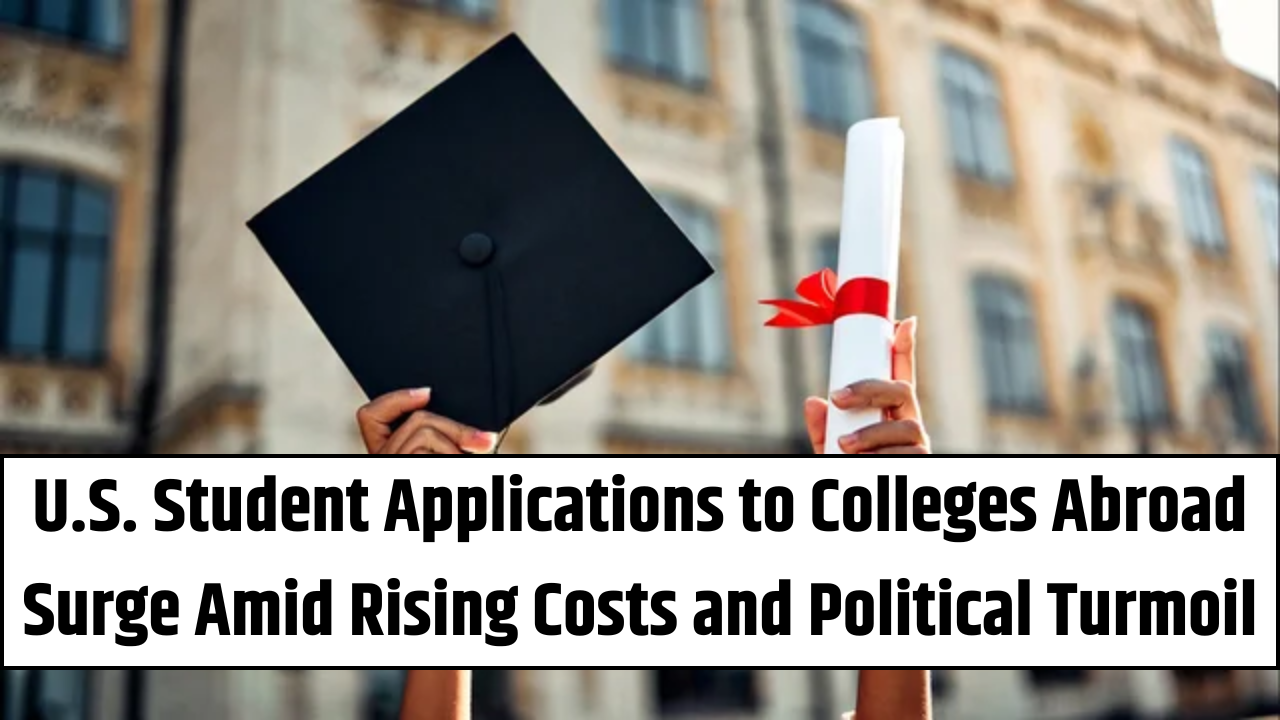
For Genevieve Smith, studying overseas was once an abstract idea. By the end of last summer, it had become a concrete plan shaped by rising tuition costs, uncertainty about her future career path, and growing unease with the political climate in the United States.
The 19-year-old California student spent two years at Santa Rosa Junior College after finishing high school, choosing to live at home while saving money and considering her long-term options. She initially explored transferring to University of California, Santa Cruz, but the financial commitment and lack of clarity about her academic focus gave her pause.

Following the 2024 election, Smith said concerns about personal safety and the broader direction of the country pushed her to look elsewhere. After narrowing her academic interests to international law, she turned her attention to Europe, where she is now preparing applications to Leiden University and Utrecht University.
Smith said she believes studying abroad will allow her to gain a global perspective she hopes to apply later as an attorney. She views an international education not just as a cost-saving move, but as a way to position herself to address global challenges more effectively.
Growing interest in overseas education
Smith is part of a broader shift among American students increasingly drawn to universities outside the U.S. Rising tuition, campus unrest, and political uncertainty have contributed to growing interest in Europe, the United Kingdom, and Asia.
According to data from the International Institute of Education, the number of U.S. students studying abroad has climbed steadily over the past five years, increasing from roughly 50,000 in 2019 to more than 90,000 by 2024, the most recent year available.
Education consultants say affordability is the primary driver, though politics also play a role. Protests on American campuses, visa disruptions affecting international students, and legal disputes between universities and the Trump administration have added to the uncertainty.
James Edge, founder of Beyond the States, said interest surged after the election. He noted a sharp rise not only in the number of inquiries, but also in the diversity of families seeking information about overseas options.

Between November 2024 and July 2025, Edge said website traffic more than doubled, while student strategy calls increased dramatically during the same period.
That momentum is also reflected in application data. UCAS reported a 14% year-over-year increase in applications from U.S. students, the largest jump since the agency began tracking the data in 2006.
Cost pressures reshape decisions
For many students, finances remain the decisive factor. Federal student loan debt in the U.S. now exceeds $1.6 trillion, according to Congress, and tuition at American four-year institutions often ranges from $11,000 to $30,000 annually. By comparison, average tuition in much of Europe and the U.K. is closer to $9,000 per year.
Jylosdet Davila, 21, told CBS News that she began exploring international universities after seeing a video on TikTok highlighting lower costs abroad. She said she wanted an education without what she described as “exorbitant” tuition fees.
After researching options through Beyond the States, Davila applied to and enrolled at Anglo-American University, where she began studying business in August 2023. She funded her education through a military family grant, personal savings, and scholarships.
Since moving to Prague, Davila said she has built friendships with classmates from across the globe and has traveled extensively, visiting more than 20 countries. She also completed a semester at Sophia University, an experience she said reshaped her view of higher education.
Benefits — and trade-offs
While Davila said she has no regrets, she acknowledged challenges that come with studying abroad, including visa requirements, navigating foreign bureaucracy, and being far from family. She also expressed concern about entering the U.S. job market without the internships, alumni networks, and recruiting pipelines that American universities often provide.
Davila said she sometimes worries her degree may not align as closely with U.S. employer expectations, and she remains undecided about whether she will return to the United States or continue living overseas after graduation.
Even so, she encourages students to seriously consider international study.
“There’s so much you can gain from it,” Davila said, adding that the flexibility and perspective gained at a young age can open doors far beyond the classroom.