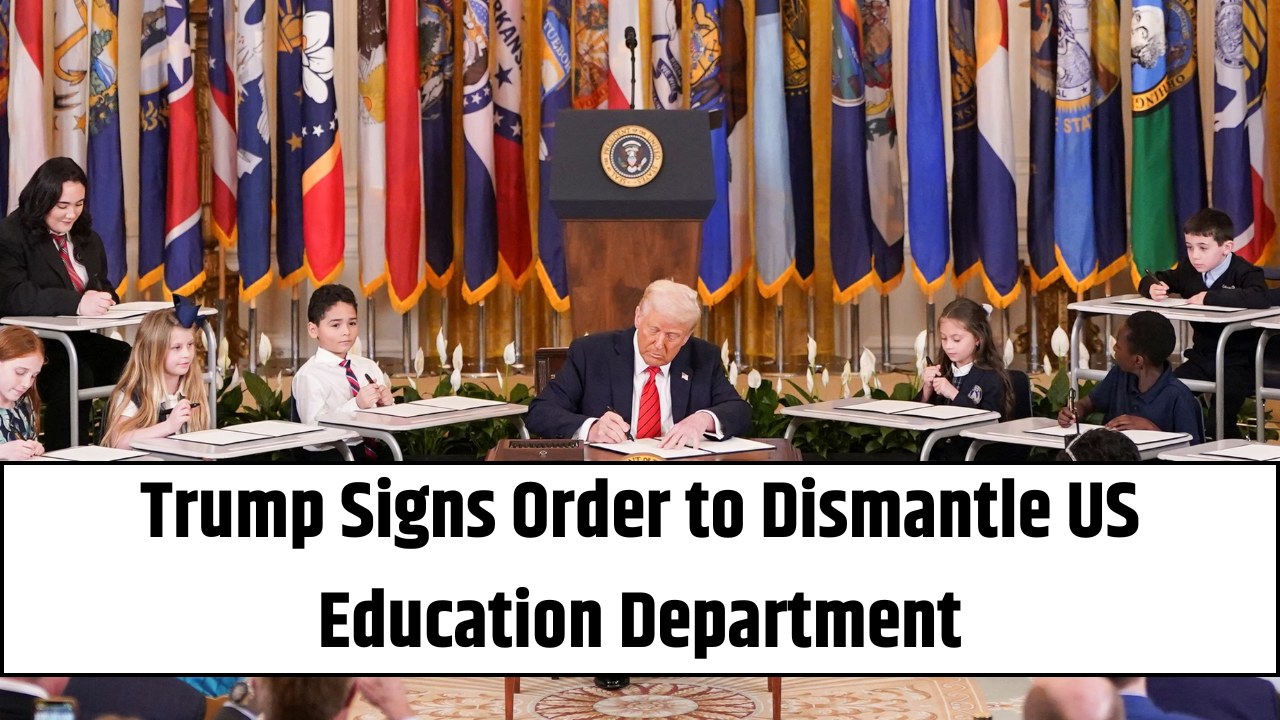
US President Donald Trump has signed a sweeping executive order directing his administration to begin dismantling the U.S. Department of Education, advancing a long-standing conservative objective and a promise from his election campaign.
Trump accused the department of chronic mismanagement and ideological overreach, arguing that education policy should be controlled by states rather than Washington. While he said the administration would act “as fast as possible,” the White House acknowledged that fully eliminating the department would require approval from Congress.

The order has already triggered legal pushback from opponents seeking to halt the move, particularly after the administration announced significant staff reductions at the agency last week.
What the Department Does — and Doesn’t — Do
Most American students attend public schools overseen by state and local governments, not the federal government. Contrary to popular belief, the education department does not run schools or set curricula. Instead, it manages student loan programs and distributes federal aid, particularly to low-income students and children with disabilities.
Federal dollars account for roughly 13% of K–12 school funding nationwide, with the bulk coming from state and local taxes. Created in 1979, the department’s budget totaled $238 billion last year—less than 2% of total federal spending.
Trump’s Rationale

At the signing ceremony, Trump claimed the US spends more on education than any other country yet fails to achieve strong academic outcomes. Data from the UNESCO Institute for Statistics shows the US spends about 5.4% of its GDP on education—higher than many nations, though not the highest globally.
Trump has repeatedly accused the department of promoting what he calls racial, sexual, and political indoctrination, a charge frequently disputed by educators and civil rights groups.
What Happens Next
The executive order instructs Education Secretary Linda McMahon to “take all necessary steps” toward closing the department while ensuring that essential programs and benefits continue uninterrupted. Trump publicly suggested he hopes McMahon will be the department’s final leader, adding that he would reassign her elsewhere in the administration.

Soon after taking office, McMahon sent a memo to the department’s roughly 4,400 employees describing the effort as the agency’s “final mission,” encouraging staff to help transition education authority back to states and local districts.
Political and Legal Hurdles
Republican Senator Bill Cassidy has announced plans to introduce legislation formally abolishing the department. However, Republicans hold a narrow 53–47 majority in the Senate, and closing a cabinet-level agency would require 60 votes, making passage unlikely.
Even without congressional approval, the administration could significantly weaken the department by cutting funding and staff—an approach already used with the U.S. Agency for International Development, which saw many of its programs halted.
The executive order does not spell out which programs might be eliminated or transferred to other agencies, though earlier reports suggested some responsibilities could be shifted to the Treasury Department.
Reaction from Educators
The American Federation of Teachers, the nation’s largest teachers’ union, condemned the move, arguing it would harm vulnerable students. The union said that while efficiency reforms are welcome, dismantling the department under the banner of fighting “woke” policies would disproportionately affect children in poverty and those with disabilities.
A Longtime Conservative Goal
Calls to abolish the education department date back more than four decades. Just two years after its creation under President Jimmy Carter, President Ronald Reagan pushed for its elimination. Despite being the smallest cabinet agency, it has remained a frequent target of conservatives seeking to reduce federal oversight.
As part of broader federal workforce reductions led by the Department of Government Efficiency, nearly 2,100 education department employees are expected to be placed on leave starting Friday. Those efforts are being overseen by billionaire entrepreneur Elon Musk, who has been tasked with helping reshape—or shutter—federal agencies.
Whether Trump’s order results in the department’s full closure or a scaled-back version with diminished authority now depends on the courts, Congress, and how aggressively the administration moves to implement its plan.