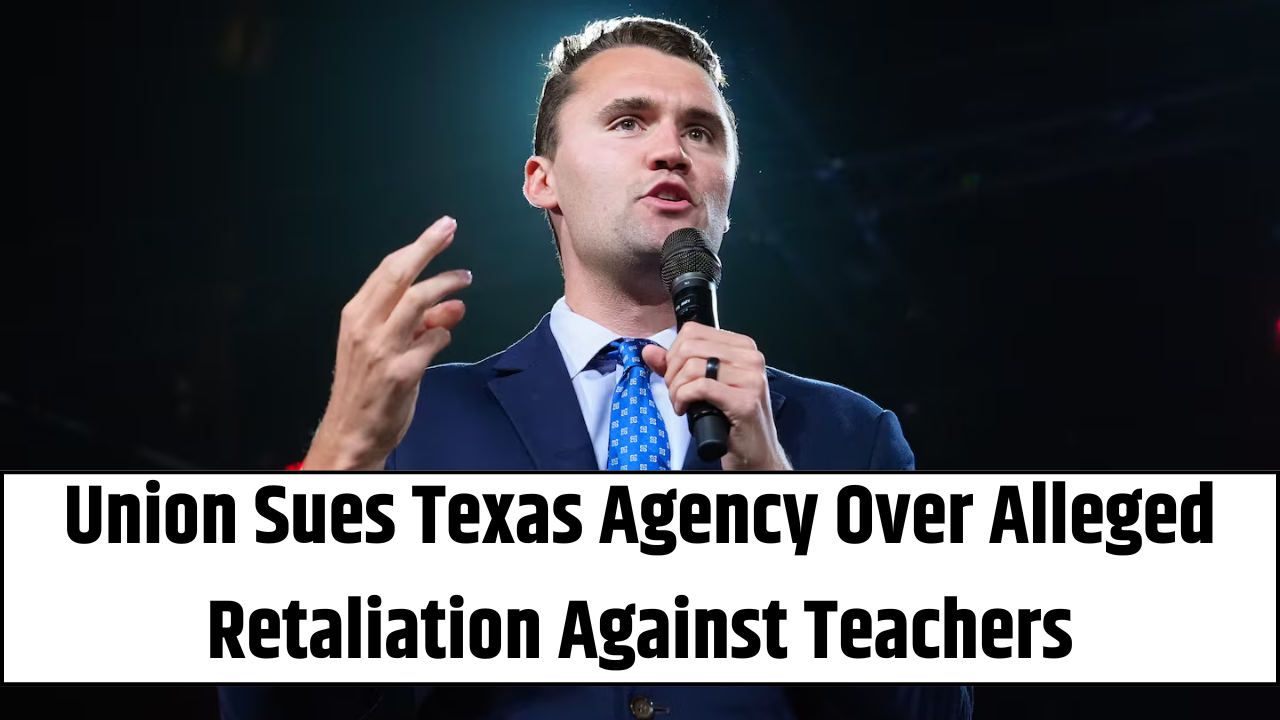
One of Texas’ largest teachers’ unions has filed a lawsuit against the state’s education agency, accusing officials of violating educators’ free speech rights by investigating their social media posts following the killing of conservative activist Charlie Kirk.
The lawsuit, filed Tuesday by the Texas American Federation of Teachers, claims the Texas Education Agency launched what the union describes as a sweeping campaign of retaliation against public school employees who posted online commentary critical of Kirk after his death last September.

According to the complaint, Education Commissioner Mike Morath directed school districts across the state to document and report what he characterized as “vile” social media content shared by educators in the aftermath of the shooting. The union argues that this directive triggered hundreds of complaints and subjected teachers to investigations without clear standards.
Kirk, a prominent right-wing figure and outspoken supporter of President Donald Trump, founded Turning Point USA in 2012. The organization grew into a major force in conservative campus activism, often drawing controversy for its views on race, gender, and immigration. Kirk was known for touring college campuses and debating students who opposed his ideology.
He was fatally shot on September 10 at Utah Valley University, an incident that sparked intense reactions nationwide, including online commentary from educators.

The lawsuit states that more than 350 complaints were submitted to the state concerning teachers’ posts, many of which criticized Kirk’s public statements or questioned the level of outrage surrounding his death compared with other acts of violence. Four cases are highlighted in court filings: one involving a veteran teacher in the Houston area and three involving educators from the San Antonio region.
According to the complaint, the Houston-area teacher, a 27-year classroom veteran, was placed on administrative leave within a day of posting questions on her public Facebook page that prompted discussion about Kirk’s death. She was later terminated following a school board meeting, despite the decision reportedly lacking majority support from board members.
The three San Antonio-area educators referenced in the lawsuit remain employed but are still under investigation. Their posts allegedly criticized Kirk’s past remarks about Black Americans, immigrants, and other marginalized groups, while also drawing attention to what they viewed as inconsistent public reactions to violence. The union emphasized that none of the posts promoted violence or caused disruptions in schools.

The Texas American Federation of Teachers, which represents roughly 66,000 members statewide, filed the case in federal court in Austin. Union President Zeph Capo said the actions of state officials have created fear among educators.
“Some Texas politicians and bureaucrats appear willing to sacrifice educators’ constitutional rights for political gain,” Capo said in a statement. “Teachers and school staff are now worried about losing their jobs, their reputations, and their ability to encourage critical thinking.”
The Texas Education Agency said it could not comment on the allegations due to ongoing litigation.
Neither Turning Point USA nor Texas Governor Greg Abbott are named as defendants in the lawsuit. However, the legal challenge comes shortly after Abbott and Lieutenant Governor Dan Patrick announced a partnership with Turning Point USA aimed at establishing student chapters at Texas high schools.
Court documents also reference a letter Morath sent to school superintendents on September 12, warning that certain social media activity could violate the state’s educator code of ethics and that each case would be individually reviewed.
The union argues that the ethics code is written so broadly that it fails to clearly define what constitutes misconduct, leaving educators vulnerable to subjective enforcement. The lawsuit seeks a court order blocking current and future investigations tied to educators’ off-duty online speech.
The filing points to longstanding legal precedent, including rulings by the Supreme Court of the United States, which hold that public employees retain First Amendment protections when speaking as private citizens on matters of public concern—so long as their speech does not interfere with workplace operations.
The case is expected to test how far states can go in regulating educators’ speech outside the classroom, particularly in politically charged moments.